
Intercellular communication in the brain through a dendritic nanotubular network
10/02/2025 Science
KLAM author: Minhyeok Chang PhD, Research Associate at Johns Hopkins University

Intercellular nanotubular networks mediate material exchange, but their existence in neurons remains to be explored in detail. We identified long, thin dendritic filopodia forming direct dendrite–dendrite nanotubes (DNTs) in mammalian cortex. Super-resolution microscopy in dissociated neurons revealed DNTs’ actin-rich composition and dynamics, enabling long-range calcium ion (Ca²⁺) propagation. Imaging and machine learning–based analysis validated in situ DNTs as anatomically distinct from synaptic spines. DNTs actively transported small molecules and human amyloid-β (Aβ); DNT density increased before plaque formation in the medial prefrontal cortex of APP/PS1 mice (APP, Aβ precursor protein; PS1, presenilin-1), suggesting that the dendrite-DNT network might play a role in Alzheimer’s disease pathology. Computational models of DNT-mediated Aβ propagation recapitulated early amyloidosis, predicting selective intracellular accumulation. These findings uncover a nanotubular connectivity layer in the brain, extending neuronal communication beyond classical synapses.
세포 간 물질 교환을 매개하는 세포간 나노튜브 네트워크가 뉴런 사이에도 존재하는지는 아직 충분히 규명되지 않았습니다. 본 연구에서는 쥐 대뇌피질에서 수상돌기 필로포디아가 인접한 수상돌기와 직접 연결되어 수상돌기 간 나노튜브(dendritic nanotube; DNT)를 형성하는 것을 확인하였습니다. 분리 배양된 뉴런에서의 초고해상도 현미경 분석을 통해 DNT가 액틴이 풍부한 역동적 구조이며 장거리 칼슘 전달을 가능하게 함을 밝혔으며, 영상 분석 및 기계학습 기반 분석을 통해 생체 내 DNT가 시냅스 가시돌기와 해부학적으로 명확히 구별됨을 검증하였습니다. 또한, DNT는 베타-아밀로이드를 비롯한 작은 분자들의 수송 통로로 기능했습니다. 알츠하이머 질환 모델 쥐의 전전두피질에서 아밀로이드 플라크 형성 이전에 DNT 밀도가 증가함을 관찰하였는데, 이는 수상돌기-DNT 네트워크가 알츠하이머병 병리에 기여할 가능성을 제시합니다. 나아가, 컴퓨터 모델링을 통해 DNT를 매개로 한 베타-아밀로이드의 전파가 특정 뉴런 내 축적을 가속화하는 것을 예측, 재현했습니다. 본 결과는 기존의 시냅스 기반 소통을 넘어, 뇌 내에 나노튜브를 통한 새로운 세포 연결망이 존재함을 시사합니다.
Epigenetic control of topoisomerase 1 activity presents a cancer vulnerability
08/12/2025 Nature Communications
KLAM author: Tae-Hee Lee PhD, Postdoctoral Research Fellow at Johns Hopkins University
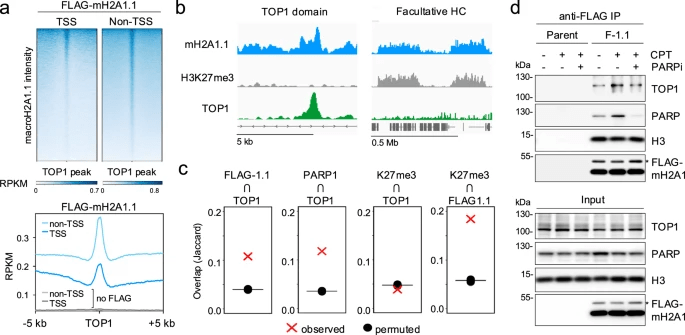
DNA transactions introduce torsional constraints that pose an inherent risk to genome integrity. While topoisomerase 1 (TOP1) activity is essential for DNA supercoil removal, the aberrant stabilization of TOP1:DNA cleavage complexes (TOP1ccs) can result in cytotoxic DNA lesions. What protects genomic hot spots of topological stress from excessive TOP1cc accumulation remains unknown. Here, we identify chromatin context as an essential means to coordinate TOP1cc resolution. Through its ability to bind poly(ADP-ribose) (PAR), the histone variant macroH2A1.1 facilitates TOP1cc repair factor recruitment and lesion turnover, thereby preventing DNA damage in response to transcription-associated topological stress. The alternatively spliced macroH2A1.2 isoform is unable to bind PAR or protect from TOP1ccs. Impaired macroH2A1.1 splicing, a frequent cancer feature, was predictive of increased sensitivity to TOP1 poisons in a pharmaco-genomic screen in breast cancer cells, and macroH2A1.1 inactivation mirrored this effect. We propose macroH2A1 alternative splicing as an epigenetic modulator of TOP1-associated genome maintenance and a potential cancer vulnerability.
Topoisomerase 1 활성의 후성유전학적 조절과 암 취약성의 분자적 기전
DNA의 동적 과정 (전사, 복제, 수선)은 위상적 제약을 유발하여 유전체 안정성을 위협합니다. Topoisomerase 1 (TOP1)은 이러한 DNA 초나선을 해소하는데 필수적이지만, 비정상적으로 안정화된 TOP1 절단 복합체 (TOP1cc)는 DNA 손상을 초래합니다. 본 연구는 히스톤 변이체 macroH2A1의 스플라이싱 변이체 중 하나인 macroH2A1.1이 PARP1 활성을 매개로 TOP1cc 유발 DNA 손상의 회복을 촉진하여 전사 관련 DNA 위상적 스트레스에 의한 손상을 억제함을 규명하였습니다. 반면 또 다른 변이체 macroH2A1.2는 poly(ADP-ribose) (PAR) 결합하지 못해 TOP1cc로부터 유전체를 보호하지 못했습니다. 또한 암에서 흔히 관찰되는 macroH2A1.1 스플라이싱 장애는 TOP1 억제제에 대한 민감성을 높였으며, 이는 후성유전적 유전체 안정성 조절과 암 취약성의 분자적 기전을 제시합니다.
Sleep need-dependent plasticity of a thalamic circuit promotes homeostatic recovery sleep
06/19/2025 Science
KLAM author: Sang Soo Lee PhD, Research Associate at Johns Hopkins University
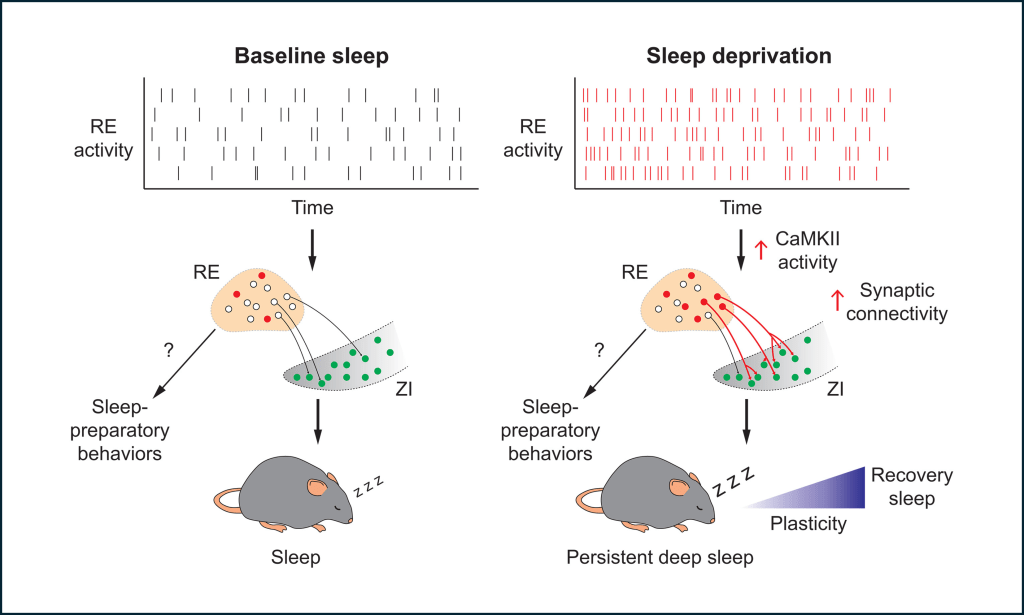
Sleep is a universal and essential behavior regulated by a homeostatic process: the longer we stay awake, the stronger our drive to sleep. What mechanisms allow the sleep drive to persist even after extended wakefulness? In this study, we identified a thalamic neural population, the nucleus reuniens (RE), projecting to the zona incerta (ZI) that plays a causal and essential role in homeostatic sleep. The RE–ZI pathway undergoes sleep-need-dependent synaptic plasticity and is modulated by a CaMKII signaling cascade. RE activation not only induces deep, prolonged sleep but also initiates naturalistic, sleep-preparatory behaviors, indicating that this circuit encodes an internal state of “sleepiness” rather than simply triggering the sleep state. The RE–ZI pathway represents the first identified “sleep drive” module: a dedicated, plastic circuit that integrates internal sleep pressure and orchestrates both behavioral and physiological components of recovery sleep.
수면은 항상성에 의해 조절되는 보편적이고 필수적인 행동입니다. 깨어 있는 시간이 길어질수록 수면 욕구는 점점 강해집니다. 그런데 이렇게 생긴 수면 욕구는, 오랜 각성 상태 이후에도 어떻게 지속될 수 있을까요? 저희는 시상의 작은 부위인 ‘재결합핵(nucleus reuniens, RE)’의 특정 뉴런 집단이 ‘불확정대(zona incerta, ZI)’로 신호를 보내면서, 수면 항상성에 핵심적인 역할을 한다는 사실을 알아내었습니다. 이 RE–ZI 경로는 수면 필요성에 따라 시냅스 가소성이 변화하며, CaMKII 신호 전달계에 의해 조절됩니다. RE를 활성화하면 깊고 오래 지속되는 수면이 유도될 뿐 아니라, 자연스러운 수면 준비 행동까지 나타납니다. 이는 이 회로가 단순히 수면을 촉진하는 것이 아니라, ‘졸림’이라는 내적 상태 자체를 부호화하고 있다는 점을 보여줍니다. RE–ZI 경로는 지금까지 밝혀진 최초의 ‘수면 욕구(sleep drive)’ 모듈로, 뇌내 수면 압력을 통합하여 회복 수면에 필요한 행동적·생리적 반응을 조율하는 유연한 회로 시스템이라 할 수 있습니다.
Punctuation Restoration Improves Structure Understanding Without Supervision
03/30/2025 10th Workshop on Representation Learning for NLP
KLAM author: Junghyun Min, PhD student at Georgetown University
Unsupervised learning objectives like autoregressive and masked language modeling constitute a significant part in producing pre-trained representations that perform various downstream applications from natural language understanding to conversational tasks. However, despite impressive generative capabilities of recent large language models, their abilities to capture syntactic or semantic structure within text lag behind. We hypothesize that the mismatch between linguistic performance and competence in machines is attributable to insufficient learning of linguistic structure knowledge via currently popular pre-training objectives. Working with English, we show that punctuation restoration as a learning objective improves performance on structure-related tasks like named entity recognition, open information extraction, chunking, and part-of-speech tagging. Punctuation restoration results in ▲≥ 2%p improvement in 16 out of 18 experiments, across 6 out of 7 tasks. Our results show that punctuation restoration is an effective learning objective that can improve structure understanding and yield a more robust structure-aware representations of natural language in base-sized models.
GPT, BERT 등 현재 언어모델에 주로 사용되는 학습 방법인 autoregressive 또는 masked language modeling은 다음 단어 예측에 뛰어난 성능을 야기하여 대화 또는 텍스트 생성 모델 학습에 유용하다. 그러나 해당 모델들은 생성 성능에 비해 구문적, 의미적 구조에 대한 이해가 떨어져 텍스트 분석 및 분류에 적합하지 않다. 이 논문에서는 인간이 언어 처리 시 운율 정보를 활용하는 점에 착안하여 문장 부호 복원을 비지도 학습 방법으로 제안하며, 해당 학습 방법이 정보 추출, 개체명 인식, 의미역 분류 등 언어 구조 관련 6개 태스크 12개 데이터셋에서 성능 향상을 이끌어냄을 확인한다.
KLAM 회원님들의 업적을 공유합니다. 아래 양식에 적어 보내주세요!


 KLAM
KLAM 